
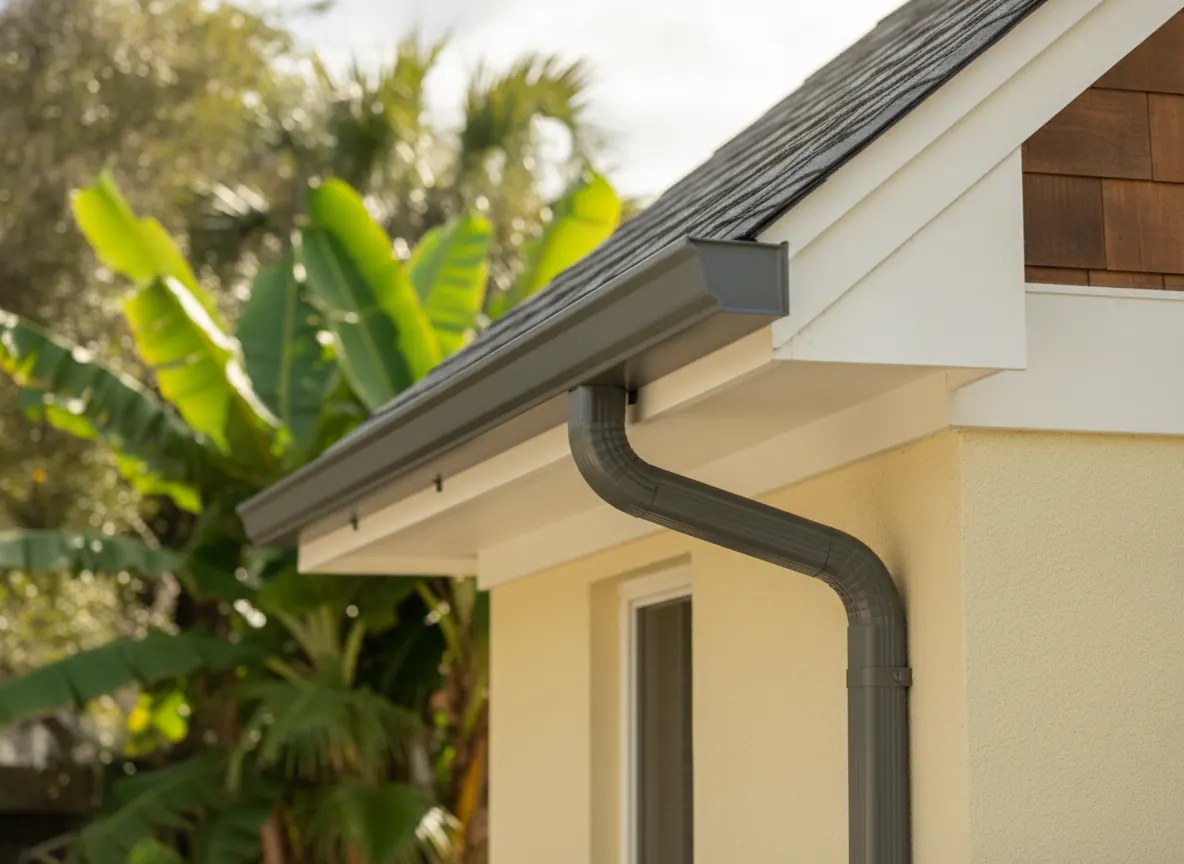
If you are getting quotes for new gutters in Baton Rouge, one of the first questions an installer will ask is size. Many homes have 5-inch K-style gutters, while several installers around the Capital Region list 6-inch seamless gutters among their main options. Is the bigger size worth it, or is it an upsell? This guide walks through the rain numbers, how gutter sizing actually works, and the situations where each size makes sense.
How much rain does Baton Rouge get?
A lot, and it comes hard. NOAA's 1991–2020 climate normals for Baton Rouge Metro Airport put average annual precipitation at 61.94 inches. That same data shows about 37 days a year with half an inch or more of rain and about 19 days a year with an inch or more. The rain is spread across the calendar, too: June (6.45 in.), August (6.37 in.) and January (6.36 in.) are the wettest months, and no month averages under 3.9 inches.
The extremes matter even more for gutters. The airport recorded 11.24 inches on a single day, August 12, 2016, and 30.96 inches for that month, the wettest month in the NOAA record there since 1930. That event was river and backwater flooding that no gutter system could have stopped, but it is a useful reminder of how much water a South Louisiana storm can drop in a short time.
Why total rainfall is not what sizes a gutter
Annual inches tell you how often your gutters work. What decides whether they overflow is rainfall intensity: how much water falls in a few minutes during a downpour. Sizing guides such as Angi's note that rainfall intensity is measured over short, 5-minute windows, and that areas with high-intensity rain need larger gutters. A summer thunderstorm that dumps water fast is the real test, not a slow, steady winter rain.
Three other things change the math on any given house:
- Roof area draining to each run. A long, uninterrupted roof plane sends far more water to one gutter than a cut-up roof with many short runs.
- Roof pitch. Steeper roofs shed water faster and can shoot it over the front lip of a small gutter.
- Valleys. Where two roof planes meet, water concentrates into a narrow stream that can overwhelm a 5-inch gutter at the corner.
5-inch vs 6-inch gutters: the real differences
| 5-inch K-style | 6-inch K-style | |
|---|---|---|
| Typical downspout pairing | 2x3 inch | 3x4 inch |
| Capacity | Standard | Noticeably more water per foot |
| Clog tolerance | Smaller opening clogs sooner | Wider trough and larger outlet pass more debris |
| Look | Slimmer profile on small homes | Heavier look; usually fine on two-story or long eaves |
| Cost | Lower per foot | Usually somewhat higher per foot |
According to Angi's gutter sizing guide, a 6-inch K-style gutter pairs with a 3x4-inch downspout and a 5-inch gutter with a 2x3. That downspout jump is a big part of the story. A gutter can only empty as fast as its downspouts, and a 3x4 downspout moves much more water than a 2x3. It is also much less likely to clog with leaves, pine needles, seed pods or shingle grit, which is a real advantage on lots with large trees.
When a 6-inch gutter makes sense in Baton Rouge
- You have overflow at corners or valleys during heavy storms, even with clean gutters.
- The house has long roof runs, a steep pitch or a two-story roofline draining onto a lower roof.
- Big trees overhang the roof and your current downspouts clog often.
- You plan to add gutter guards. Some guards reduce how much water the gutter can take in a downpour, so extra capacity helps.
- Water is pooling near the foundation, and you want fewer, larger downspouts feeding an underground line or drain.
On flat, slow-draining lots this matters more than you might think. USDA soil survey data show that most mapped soils in East Baton Rouge Parish are somewhat poorly to very poorly drained, and the share is higher in Ascension, Livingston and West Baton Rouge parishes. When gutters overflow, that water lands right next to the slab. Our downspouts and drainage page covers what installers do to move it away.
When 5-inch gutters are still fine
A 5-inch system is not automatically wrong. It can work well on a single-story house with short, simple roof runs, a moderate pitch, few overhanging trees and enough downspouts. Some homeowners also prefer the slimmer look on a small cottage or a historic facade. If your existing 5-inch gutters never overflow when clean, an installer may simply suggest adding an extra downspout or upsizing the downspouts to 3x4 rather than changing the whole gutter.
The worst outcome is choosing on price alone and ending up with a gutter that overflows every summer storm. Ask each installer to explain why they recommend a size for your roof, not just "that's what we use."
What about 7-inch and commercial-size gutters?
Some local installers also offer 7-inch K-style or commercial box gutters. They are mainly for very large roofs, low-slope commercial buildings or unusual drainage problems. On a typical house, a well-placed 6-inch gutter with 3x4 downspouts covers most situations. If a quote proposes something larger, ask how the installer measured your roof area and where the water will go once it leaves the downspout.
Does size change the price much?
Sizing is one of several cost factors, alongside total footage, number of stories, material, downspout count and drainage. Published cost guides give these typical ranges for Baton Rouge. They are estimates, not quotes, and the sources disagree:
- Seamless aluminum, Baton Rouge (HomeBlue, 2025): about $5.90–$10.30 per linear foot installed.
- Installed aluminum, Baton Rouge: roughly $880–$1,550 for 150 ft, $1,180–$2,060 for 200 ft and $1,470–$2,580 for 250 ft.
- Aluminum downspouts: about $9–$12 per foot.
- Two-story add-on: about +$1–$3 per foot.
A 6-inch system usually lands toward the higher end of the per-foot range, and the larger downspouts add a bit more. The only way to know your number is an installer's on-site measurement. See the full breakdown on our gutter installation cost page.
Questions to ask installers about size
- Which size do you recommend for this roof, and why?
- How many downspouts, what size, and where will each one drain?
- What gauge or thickness of aluminum is in the quote?
- How are the hangers spaced, and what kind are they?
- If I add guards later, will this size and outlet handle heavy rain?
Comparing two or three written quotes with the same questions makes the differences clear quickly. You can read more about seamless gutter installation, compare gutter guard types for oak and pine debris, or see how the quote process works.
Get sized correctly the first time
We connect Baton Rouge-area homeowners with independent local gutter installers for free, no-obligation quotes. Tell us a little about your home, and an installer can measure the roof, check your downspout layout and recommend a size that fits how hard it rains here. Request your free quote.