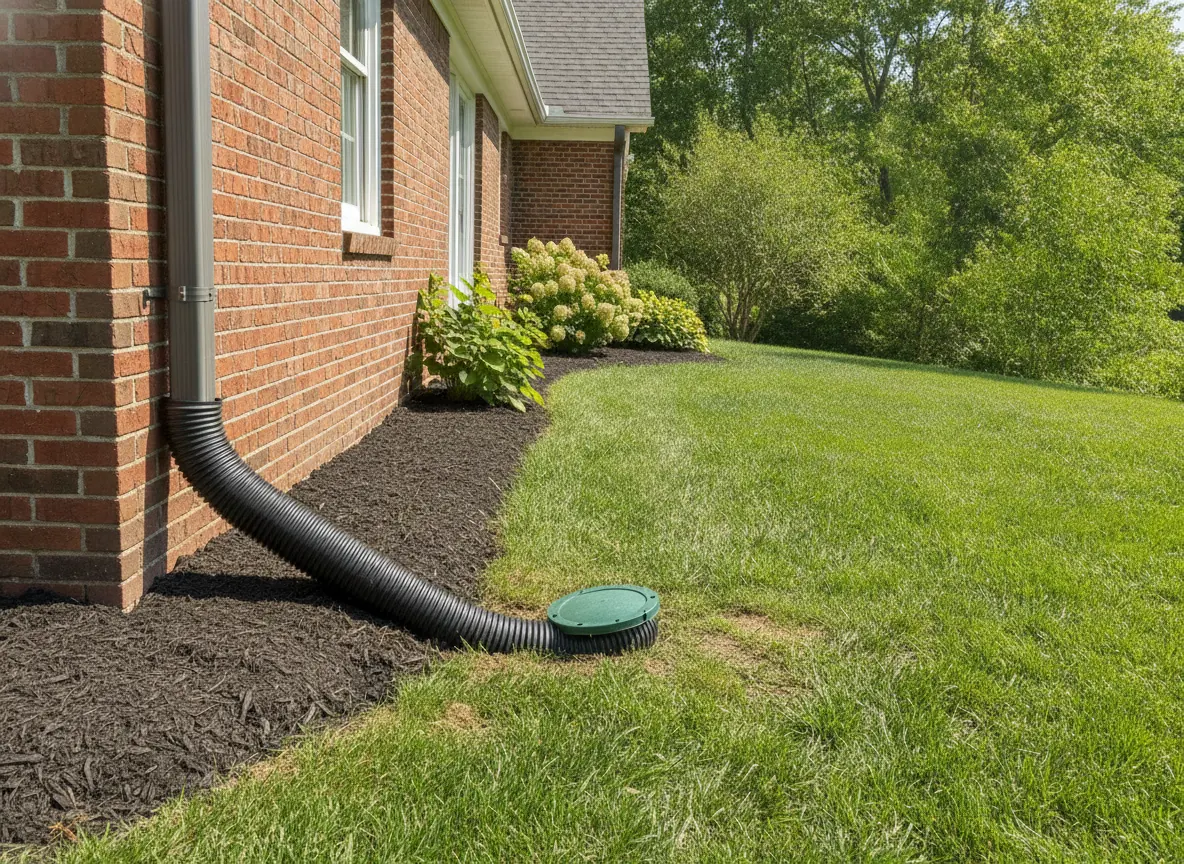
Where does a French drain empty?
A French drain has to end somewhere lower than where it starts: often a pop-up emitter in a lower part of the yard, a dry well, or a ditch or street drain. On flat Baton Rouge lots, finding enough fall is the hard part. Tying into a street, ditch or public drainage may involve parish rules, so check with your parish before that work is planned.
What is the difference between a French drain and an underground downspout?
An underground downspout line is a solid pipe that carries roof water from a downspout to an outlet away from the house. A French drain is a perforated pipe in a gravel trench that collects water already in the soil or on the surface. Many soggy yards need one or the other; some need both, connected to separate outlets.
How much does a French drain cost?
A 2026 cost guide (LawnStarter) puts exterior French drains at about $10–$65 per foot, or roughly $1,000–$6,500 for 100 feet. That is a wide range because trench depth, pipe, gravel, fabric, outlets and access all change the price. These are estimates, not quotes; your price comes from an installer who has walked the lot.
Why does water pond near my foundation?
Across the Baton Rouge metro, USDA soil survey data show mostly flat, slow-draining soils, so water dumped at the base of a downspout tends to sit. Short or missing extensions, clogged gutters, soil sloping toward the house and undersized downspouts all make it worse. Moving roof water several feet away, or underground to a lower outlet, is often the first fix to price.
Do underground downspout lines clog?
They can. Leaves, shingle grit and roots can build up, especially where the pipe has low spots or no cleanout. Gutter guards upstream, smooth-wall pipe, steady slope and a cleanout near the downspout all help. Ask installers what pipe they use, how they keep a steady slope on a flat lot, and how the line can be flushed later.