
Ask a Baton Rouge homeowner what worries them about rain and you'll usually hear about street flooding. A quieter problem plays out right next to the house: roof water landing at the foundation and soaking into soil that doesn't want to drain. This post looks at what USDA soil survey data say about the ground under the Capital Region, how that interacts with gutters and downspouts, and what drainage options homeowners typically weigh.
How much water comes off a Baton Rouge roof?
NOAA's 1991–2020 normals for Baton Rouge Metro Airport put average annual precipitation at about 61.94 inches. The same normals show roughly 37 days a year with half an inch or more of rain and about 19 days with an inch or more. Rain is spread across the calendar, too: January averages about as much as June and August, and no month averages under about 3.9 inches.
A roof concentrates all of that. Every square foot of shingles sheds its rain into the gutters, and the gutters funnel it to a handful of downspouts. If each downspout ends at a splash block a foot from the slab, you've taken water that fell across the whole roof and parked it in a few spots against the foundation.
What USDA soil survey data show about Capital Region soils
The USDA's soil survey (the NRCS SSURGO database) maps soils parish by parish. Summarizing that data by map-unit acreage gives a rough picture of the four core parishes. These are approximate figures from our own tally of the survey data, not an official published NRCS statistic, and they leave out water and urban-land units:
| Parish | Somewhat poorly to very poorly drained | Moderate or high shrink-swell | High shrink-swell |
|---|---|---|---|
| East Baton Rouge | about 80% | about 67% | about 9% |
| Livingston | about 89% | about 75% | about 40% |
| Ascension | nearly all | about 92% | about 51% |
| West Baton Rouge | about 90% | about 87% | about 52% |
Two things stand out. First, most of the metro's mapped soil is rated somewhat poorly to very poorly drained, and slopes of 0–1% dominate, so water tends to sit rather than run off. Second, soils with moderate-to-high shrink-swell potential cover most of the area, and the share of high shrink-swell soils climbs sharply outside East Baton Rouge, in Ascension (Prairieville, Gonzales), West Baton Rouge (Port Allen) and Livingston (Denham Springs, Walker). Ascension's mapped soils include Schriever clay, and East Baton Rouge's largest units include Oprairie silt and Gilbert silt loam.
Researchers have noticed this too. A 2021 LSU and Eustis Engineering study in Frontiers in Built Environment named Baton Rouge among southern urban centers with the largest maximum estimated expansive-soil property losses, and tied swelling to heave when moisture is added to the soil.
Why shrink-swell clay cares where your downspouts end
Expansive clay swells when it gets wet and shrinks as it dries. Under a house, the problem isn't one wet day; it's uneven, repeated wetting. If one corner of the slab gets a downspout's worth of water every storm while the rest of the perimeter stays drier, the soil under that corner goes through bigger swings than the soil elsewhere. Uneven movement is what homeowners tend to notice as sticking doors, cracks in brick or drywall, or gaps at trim.
Gutters alone don't cause or cure that, and a crack can have many causes. If you see signs of foundation movement, a structural engineer or foundation specialist is the right first call. What gutters and downspouts can do is stop the roof from adding concentrated water in the worst possible spots.
Can gutters cause water damage?
Yes, when they're not doing their job. Common ways gutters make water problems worse:
- Short discharge. A downspout that ends at the foundation delivers the entire roof section's water to one spot of slow-draining soil.
- Overflow. Clogged or undersized gutters spill over the front edge in heavy rain, dropping a sheet of water along the drip line beside the slab.
- Leaking seams and corners. Sectional gutters can drip at joints, wetting fascia and the ground below.
- Poor pitch. Gutters that sag or slope the wrong way hold water and overflow at low points.
- Too few downspouts. Long runs feeding a single small outlet back up quickly in a cloudburst.
Sizing matters here. A 6-inch K-style gutter is usually paired with a larger 3x4 downspout, while a 5-inch gutter pairs with a 2x3. Our post on 5" vs 6" gutters for Baton Rouge rain goes deeper.
Options for moving roof water away from the foundation
Installers and drainage contractors typically talk through a ladder of options, from simple to involved:
Downspout extensions and splash blocks
The cheapest fix: extend each downspout so it discharges several feet from the house, onto ground that slopes away. On very flat lots, the water may still drift back, so this works well where the yard has some fall.
Underground downspout lines
A solid pipe buried from the downspout to a lower spot in the yard, often ending at a pop-up emitter that opens when water flows. This keeps discharge out of sight and away from the slab. On flat Baton Rouge lots, the challenge is finding enough fall for the pipe, and lines can clog if gutters send leaves and grit down them.
French drains
A French drain is a trench with perforated pipe in gravel that collects groundwater and surface water and carries it to an outlet. It solves a different problem from an underground downspout line: it intercepts water already in the soil, while a downspout line carries roof water in a closed pipe. Homeowners searching for "gutters and French drains" often need both, but they shouldn't usually be tied into the same pipe without planning, since a downspout can overwhelm a French drain in a heavy storm. Our French drain vs underground downspout guide compares them side by side.
Gutter guards
Guards don't move water away from the house, but they help keep debris out of downspouts and underground lines. See gutter guards for how the common types compare.
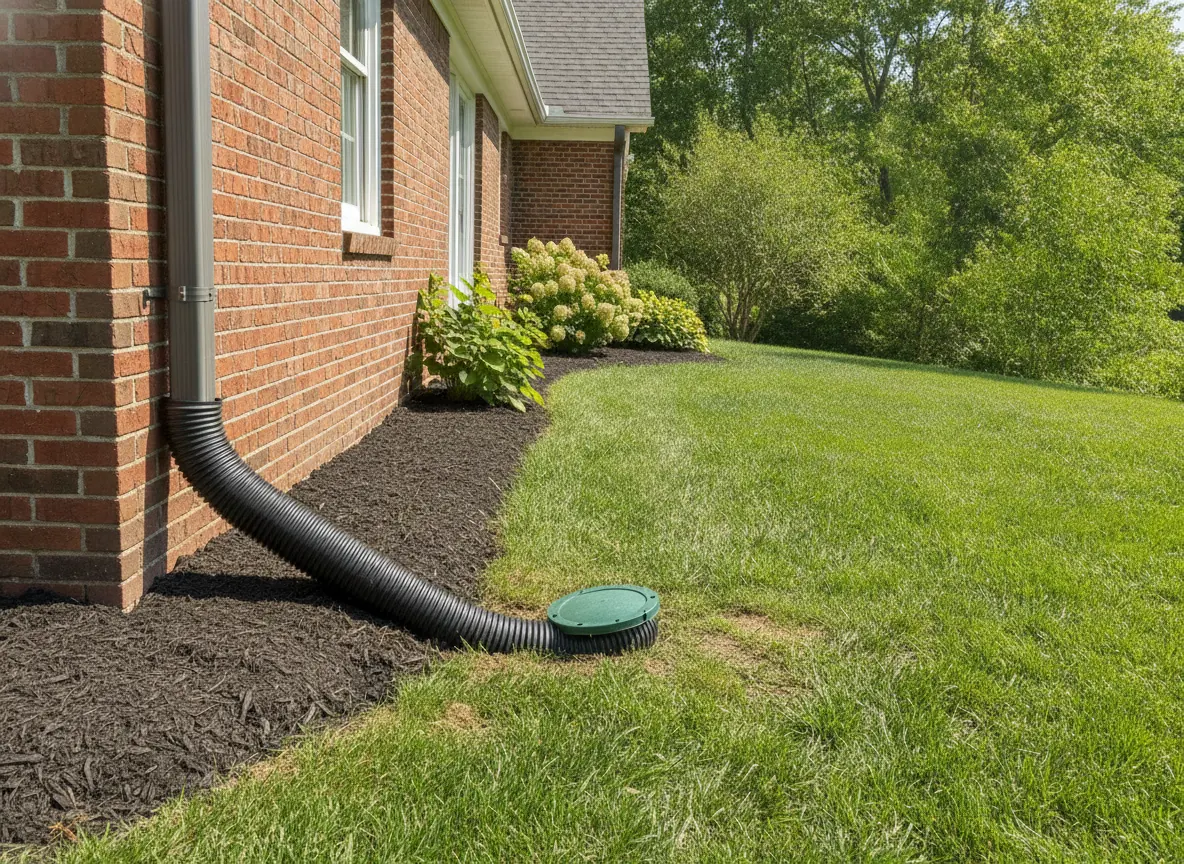
Where should a downspout drain?
Ideally, to a point lower than the foundation and far enough out that the water won't flow back. Avoid aiming discharge onto a neighbor's lot: East Baton Rouge's 311 guidance says the City-Parish gets involved in neighbor runoff mainly through the building permit process or when something blocks a dedicated drainage servitude, so most lot drainage is the owner's responsibility. If a line would tie into a street, ditch or public right-of-way, check with your parish permit office or public works department first.
What does drainage cost?
Typical ranges from cost guides (estimates, not quotes):
| Item | Typical range |
|---|---|
| Aluminum downspouts | $9–$12 per ft |
| French drain | $10–$65 per ft (100 ft: $1,000–$6,500) |
| Seamless aluminum gutters, Baton Rouge (HomeBlue, 2025) | $5.90–$10.30 per linear ft installed |
The sources disagree, and the real number depends on footage, number of stories, material, downspout count and how much drainage the lot needs. An installer's on-site measurement sets the actual price. The gutter installation cost guide has the full table.
A word about 2016
August 2016 brought the wettest month on record at Baton Rouge Metro Airport, about 31 inches, and devastating river and backwater flooding across the region. Gutters and downspouts don't prevent that kind of flooding and shouldn't be sold as if they do. Their job is everyday roof water: the 60-plus inches a year that otherwise lands beside the slab.
A quick checklist for your next rainstorm
- Walk the perimeter during a steady rain. Note any gutter that overflows or downspout that pools at the slab.
- Look for soil washouts, mulch scattered along the drip line, or standing water that lingers a day later.
- Check that downspouts discharge onto ground that falls away from the house.
- After the storm, look for sagging runs or seams that dripped.
- Write down what you saw. It helps an installer recommend the right mix of gutters, downspouts and drainage.
Get quotes for gutters and drainage
We connect Baton Rouge-area homeowners with independent local gutter installers for free, no-obligation quotes. Tell us what you've noticed and an installer can typically walk the lot, measure the roofline and suggest options, from seamless gutters to downspouts and drainage. Ready to compare? Request a free quote.